Beyond the Barrel: How Renewable Grid Intelligence Changes the Energy Conversation
The energy transition isn't replacing oil and gas operations, it's adding complexity to them. Operators managing both hydrocarbon infrastructure and renewable assets need an intelligence model that sees the full picture. The ones who build it become the operators who matter in both conversations.

The Conversation Is Shifting, But Not the Way You Think
There’s a narrative that frames the energy transition as a replacement story: renewables in, hydrocarbons out. That framing makes for good headlines and bad operational strategy.
What’s actually happening is more interesting and more difficult. The energy mix is expanding. Hydrocarbon operators aren’t disappearing, they’re adding renewable generation, battery storage, hydrogen production, and distributed energy resources to portfolios that still include pipelines, refineries, and production fields. Utilities aren’t choosing between fossil and renewable generation, they’re managing grids where both coexist, where intermittent supply from wind and solar must be balanced against baseload from gas and coal, where demand response programs add another variable to an already complex dispatch problem.
The operational complexity isn’t shrinking. It’s compounding.
And here’s the part that most technology conversations miss: the intelligence infrastructure needed to manage a diversified energy portfolio is fundamentally the same architecture needed to manage pure hydrocarbon operations well. Real-time data from distributed assets. Predictive models that account for multiple variables. Compliance automation across regulatory frameworks. Equipment-level performance monitoring that informs maintenance and investment decisions.
The operator who builds operational intelligence for their pipeline network has already built the foundation for managing a wind farm, a solar installation, or a battery storage array. The data models are different. The reasoning architecture is the same.
The Grid Complexity Problem
Consider what a modern grid operator faces.
Transmission infrastructure (some of it decades old) carries power from centralized generation to load centers. Distribution networks, designed for one-way power flow, now handle two-way flow as rooftop solar and behind-the-meter batteries feed energy back into the grid. Utility-scale wind and solar installations generate power on nature’s schedule, not demand’s schedule. Battery storage systems smooth the gaps, but their optimal charge-discharge cycles depend on price signals, weather forecasts, grid congestion, and regulatory constraints that change hourly.
On the demand side, large industrial consumers are shifting loads to match renewable availability, participating in demand response programs, and installing their own distributed generation. Electric vehicle charging adds another demand pattern that doesn’t match historical load curves.
Managing this grid with the tools designed for centralized, one-way, baseload-dominated generation is like navigating a highway interchange with a road map from 1975. The terrain has changed. The intelligence model hasn’t.
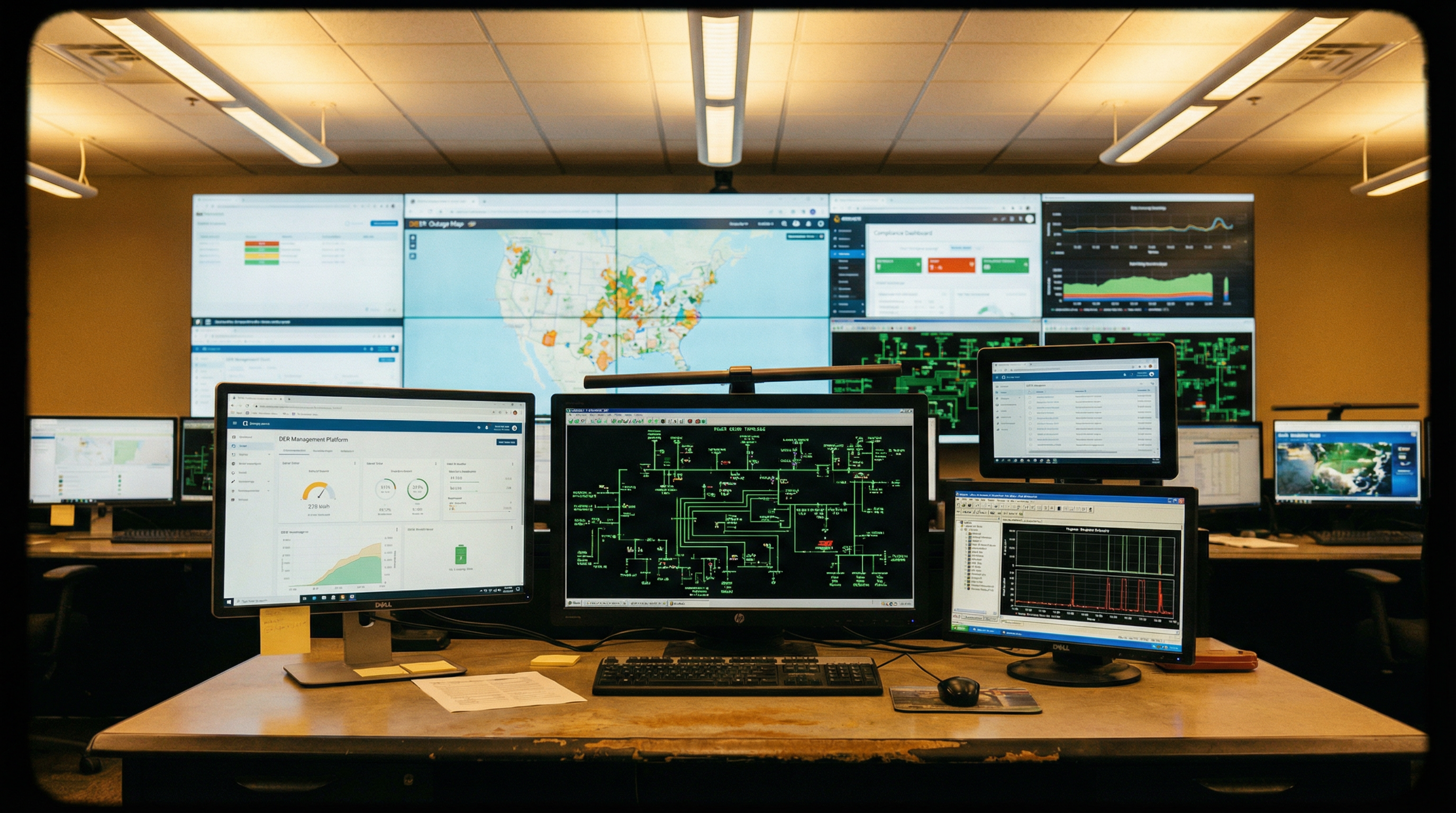
What grid operators need isn’t more dashboards showing more data. They need a reasoning layer that correlates across domains: generation profiles from multiple sources, transmission constraints, distribution network conditions, storage state-of-charge, demand patterns, weather forecasts, and regulatory compliance requirements, all informing dispatch decisions in real time.
The Emissions Dimension
Here’s where the energy transition conversation intersects directly with environmental governance.
Every kilowatt-hour on a modern grid carries an emissions profile. When a grid operator dispatches gas peaker plants to cover a shortfall in wind generation, the carbon intensity of the grid changes. When battery storage discharges during peak demand (avoiding the need for that peaker plant), the emissions profile shifts again. When an industrial consumer shifts load to a period of high renewable generation, their Scope 2 emissions decrease.
Tracking this accurately (not with annual averages but with real-time, time-stamped emissions data tied to specific generation sources and consumption patterns) is what IFRS S2, CSRD, and SEC climate disclosure rules increasingly require.
For utilities, this means every dispatch decision has an emissions consequence that needs to be documented. For industrial consumers, this means their energy procurement strategy is also their emissions reduction strategy, and they need the data to prove it.
The grid intelligence system that optimizes dispatch for reliability and cost also generates the emissions data that compliance frameworks require. Same operational model. Different output. The operator who builds the intelligence layer once serves both purposes.
What Hydrocarbon Operators Already Know
Here’s what’s underappreciated in the energy transition conversation: hydrocarbon operators are among the most sophisticated operational intelligence users in the world.
Managing a pipeline network requires real-time monitoring across thousands of kilometers. Refinery operations require process optimization across hundreds of interdependent variables. Production operations require reservoir modeling, artificial lift optimization, and predictive maintenance on equipment operating under extreme conditions. These operators know how to manage complex, distributed, sensor-dense environments.
The challenge isn’t capability. It’s integration. The pipeline monitoring system doesn’t talk to the wind farm SCADA. The refinery optimization model doesn’t account for the emissions profile of the electricity it consumes. The production operations team manages field assets independently from the renewable generation assets that might be co-located on the same lease.
When an integrated energy company (one that operates both hydrocarbon infrastructure and renewable generation) connects these operational domains into one intelligence model, the compound insights are immediate.
Gas pipeline throughput optimization considers the emissions impact alongside the economics. Renewable generation forecasts inform refinery energy procurement decisions. Equipment maintenance schedules across both hydrocarbon and renewable assets are prioritized by a common model that weighs operational risk, emissions impact, and regulatory deadlines simultaneously.
This isn’t a theoretical future. It’s what happens when the operational intelligence infrastructure built for hydrocarbon operations extends to encompass the full energy portfolio.
The LATAM Opportunity
Latin America illustrates this dynamic clearly.
Ecuador’s energy mix includes hydroelectric generation (over 75% of capacity), thermal backup, and a growing portfolio of wind and solar. The operational challenge is managing this mix, particularly when drought reduces hydro availability and thermal generation must increase, with corresponding emissions implications.
Chile is pursuing green hydrogen production at scale, drawing on some of the best solar resources on the planet. The operational intelligence challenge: connecting solar generation forecasts, electrolyzer performance, hydrogen storage logistics, and export scheduling into one operational model.
Colombia’s Ecopetrol has committed to net-zero by 2050 and is diversifying into wind and solar. The company needs an intelligence model that spans its hydrocarbon operations and its growing renewable portfolio, and proves the emissions trajectory to investors and regulators.
Brazil’s new emissions trading system creates a direct financial link between operational emissions and corporate costs. Operators who can attribute emissions to specific equipment and time periods can optimize their position. Operators using facility-level estimates are exposed to both compliance risk and financial inefficiency.
In each case, the opportunity isn’t “choose hydrocarbons or renewables.” It’s “build the intelligence infrastructure that manages both and proves the environmental outcomes.”
The Positioning Advantage
The energy companies that emerge strongest from the transition won’t be defined by which assets they own. They’ll be defined by whether they can manage a complex, diversified energy portfolio with the same operational precision they bring to a single-asset-class operation.
That precision requires operational intelligence: the ability to see across asset classes, correlate operational data with environmental outcomes, optimize for multiple objectives simultaneously, and prove compliance across frameworks that each want a different slice of the same underlying data.
The operators who build this intelligence model on their existing hydrocarbon operations (then extend it to encompass renewables, storage, and grid services) don’t just participate in the energy transition. They lead it. Because they’re not choosing between conversations. They’re the operators who can speak credibly in both.
The energy conversation is bigger than the barrel. The operators who see the full picture first are the ones who shape what comes next.