The Data Integrity Problem in Carbon Markets: Why Digital MRV Changes Everything
The voluntary carbon market hit $2 billion in 2023 and is projected to reach $15.8 billion by 2030. But the market's growth is constrained by a fundamental problem: buyers can't verify what they're buying. Digital MRV (measurement, reporting, and verification built on IoT sensors, satellite data, and immutable audit trails) is the infrastructure that makes carbon credits trustworthy.
A Market Built on Trust It Hasn’t Earned
The voluntary carbon market (VCM) is one of the most important financial mechanisms for climate mitigation. Companies that can’t eliminate emissions entirely purchase carbon credits from projects that reduce, avoid, or remove greenhouse gases elsewhere, forest conservation, renewable energy installations, methane capture, direct air capture, and soil carbon sequestration.
The market is growing rapidly. Transaction volumes exceeded $2 billion in 2023. Projections from the Taskforce on Scaling Voluntary Carbon Markets put the market at $15.8 billion by 2030, with some estimates reaching $50 billion. Major corporations (Microsoft, Stripe, Google, Shell, Delta) have committed billions in carbon credit purchases as part of their net-zero strategies.
But the market has a credibility problem.
A series of investigations between 2023 and 2025 revealed that significant portions of certified carbon credits (projects that had been verified by established standards bodies) didn’t deliver the emissions reductions they claimed. REDD+ forest conservation projects that claimed to prevent deforestation in areas where deforestation wasn’t actually happening. Renewable energy projects that would have been built regardless of carbon credit revenue. Cookstove projects where the stoves weren’t being used. Methane capture projects where the baseline measurements were wrong.
The investigations didn’t just embarrass individual projects. They called into question the entire verification architecture. How can a buyer know that the credit they’re purchasing represents a real, additional, permanent emissions reduction?
The answer (the only answer that scales) is better data.
How Verification Works Today (And Why It Fails)
The current MRV (measurement, reporting, and verification) process for carbon credits typically works like this:
A project developer designs a carbon reduction project and selects a methodology from a standards body, Verra, Gold Standard, American Carbon Registry, or others. The developer calculates expected emissions reductions using that methodology, which includes baseline assumptions about what would have happened without the project.
An independent third-party auditor visits the project site periodically (typically annually) to verify that the project is operating as described and that the emissions reductions are real. Based on these periodic audits, the standards body issues carbon credits.
The structural weaknesses are embedded in the process.
Baselines are modeled, not measured. The emissions reductions a project claims are calculated relative to a baseline, what would have happened without the project. For forest conservation, this means modeling a deforestation rate that would have occurred. For methane capture, it means estimating the methane that would have been released. These baselines are inherently assumptions. When the assumptions are wrong, the credits are overstated.
Verification is periodic, not continuous. An annual site visit captures a snapshot. Between visits, the project operates unsupervised. A forest conservation project could lose significant tree cover between audits. A methane capture system could malfunction for months before anyone checks.
Data is self-reported. Project developers report their own performance metrics. Auditors verify what they can during site visits, but the day-to-day data comes from the developer. The incentive structure (more reductions claimed means more credits issued means more revenue) doesn’t favor conservative reporting.
Permanence is assumed, not monitored. A forest conservation project that prevents deforestation in year one might lose that forest to fire, disease, or land-use change in year five. A soil carbon project that sequesters carbon through regenerative agriculture might release it if farming practices change. The credit was issued based on a point-in-time verification. Ongoing permanence isn’t continuously monitored.
What Digital MRV Looks Like
Digital MRV replaces the assumptions, snapshots, and self-reporting with continuous, sensor-sourced, independently verifiable data.
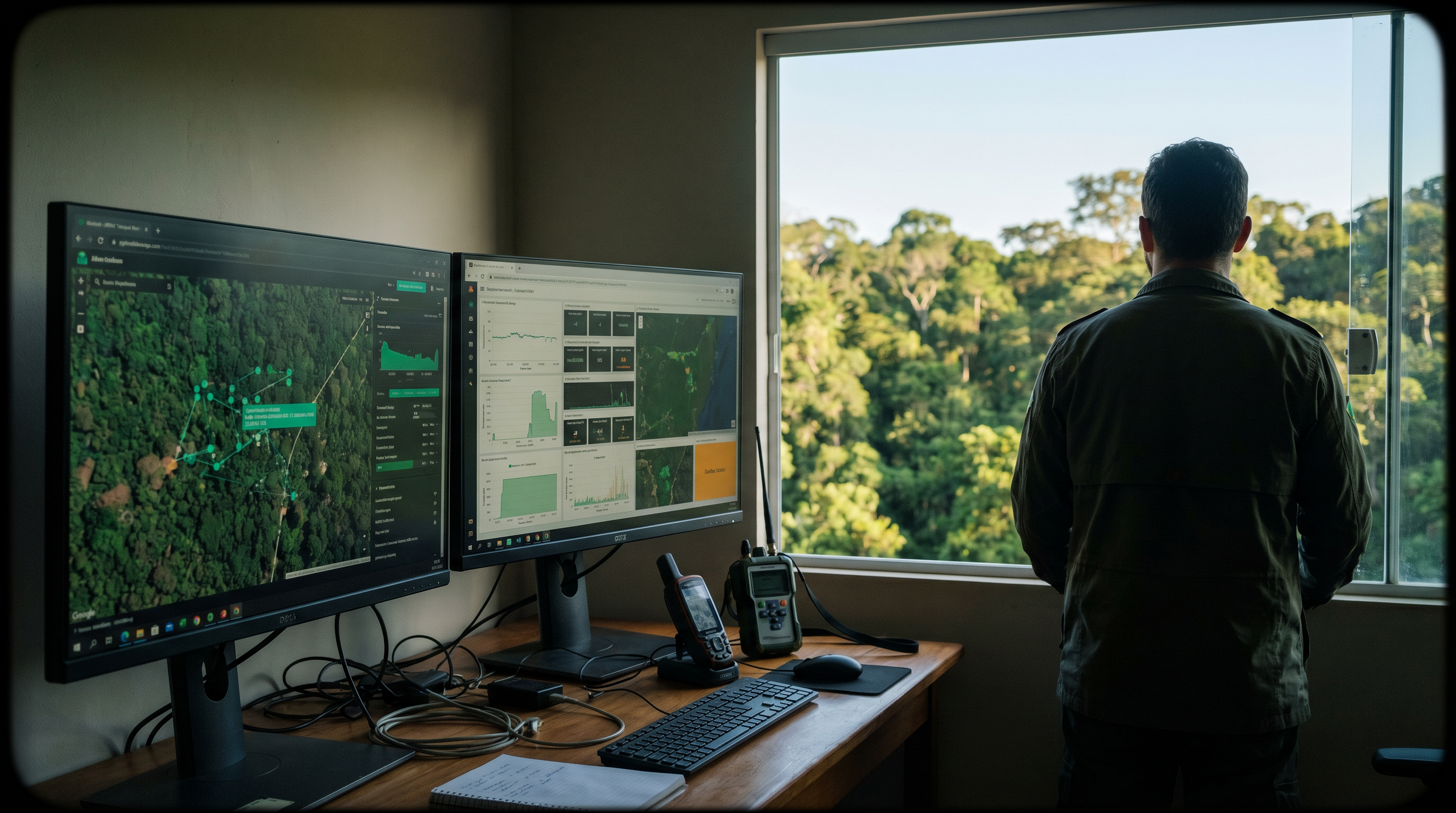
Continuous measurement. IoT sensors deployed at project sites measure the relevant environmental variables in real time. For methane capture projects: flow meters, gas analyzers, and pressure sensors measuring actual volumes captured. For forest conservation: remote sensing via satellite, drone, and ground-based sensors measuring canopy cover, biomass, and land-use change. For soil carbon: sensors measuring soil organic carbon at multiple depths with time-series tracking.
Satellite verification. Earth observation data (from commercial satellite constellations and public programs like Copernicus and Landsat) provides independent verification of ground-level claims. A forest conservation project reporting maintained canopy cover can be verified against satellite imagery on weekly or monthly cycles. A renewable energy installation’s output can be cross-referenced with solar irradiance data and satellite-visible infrastructure changes.
Immutable audit trails. Measurement data from sensors and satellites is timestamped and recorded in systems where it can’t be altered after the fact. This doesn’t require blockchain, although blockchain-based registries like Toucan and KlimaDAO are implementing this approach. What it requires is chain-of-custody from measurement to credit issuance that an auditor or buyer can trace independently.
Dynamic baselines. Instead of modeling what “would have happened” using static assumptions, digital MRV can establish baselines from comparable reference areas monitored with the same sensor infrastructure. A REDD+ project’s baseline isn’t a modeled deforestation rate, it’s the observed deforestation rate in similar, unprotected areas during the same time period, measured with the same remote sensing tools.
Continuous permanence monitoring. Once a credit is issued, the monitoring doesn’t stop. The same sensor infrastructure that verified the initial reduction continues monitoring for reversals. If a forest conservation project loses tree cover, the system detects it and can trigger credit retirement or replacement.
The Architecture Gap
Here’s where the opportunity crystallizes. Digital MRV requires exactly the kind of operational intelligence architecture that complex industrial operations already need: multiple sensor types, multiple data sources, continuous monitoring, automated reporting, and governed audit trails.
The components exist individually. IoT sensor networks can be deployed at project sites. Satellite imagery is commercially available. Data platforms can aggregate and normalize sensor data. Blockchain and tamper-resistant databases can provide immutable records.
What doesn’t exist (and what the carbon market desperately needs) is the integration layer that connects these components into a governed operational model. A system that ingests sensor data from IoT networks, correlates it with satellite imagery, validates it against reference baselines, maintains chain-of-custody from measurement to credit, generates the documentation that standards bodies and auditors require, and monitors permanence continuously after issuance.
This is the same architectural pattern that operational intelligence provides in other domains: connect the data sources, correlate across them, govern the outputs, and maintain audit trails. The domain is different. The architecture is the same.
Where the Market Is Heading
Several converging forces are accelerating the shift toward digital MRV.
Buyer sophistication is increasing. After the credibility investigations of 2023-2025, major corporate buyers are demanding higher-quality credits with verifiable data. Microsoft’s carbon removal purchases, for example, require digital MRV with continuous monitoring. The buyers with the largest budgets are setting the quality floor for the market.
Regulatory integration is arriving. Brazil’s new emissions trading system (ETS) will require standardized monitoring and reporting. The EU Carbon Border Adjustment Mechanism (CBAM) demands verifiable emissions data for imported goods. Article 6 of the Paris Agreement, governing international carbon trading, specifies rigorous accounting and verification requirements. Each regulatory layer increases the data quality threshold.
CCUS monitoring needs the same infrastructure. Carbon capture, utilization, and storage programs, Abu Dhabi’s Habshan facility (1.5 mtpa, coming online 2026), QatarEnergy’s North Field expansion (2.2 mtpa), Saudi Arabia’s Jubail hub (9 mtpa by 2028), Petrobras’s pre-salt operations (14.2 mtpa), all need continuous monitoring of capture rates, storage integrity, and leakage detection. The MRV infrastructure for CCUS and for carbon credit verification is fundamentally the same: sensors, satellite, integration, governance.
Registry standards are tightening. Verra, Gold Standard, and the Integrity Council for the Voluntary Carbon Market (ICVCM) are all revising their standards to incorporate digital MRV requirements. Projects that can demonstrate continuous, sensor-sourced monitoring will receive preferential treatment. Projects relying on periodic manual audits will face increasing scrutiny and potential credit devaluation.
The LATAM and MENA Dimension
Two regions where carbon market activity is intensifying offer clear illustrations of the digital MRV opportunity.
LATAM is home to many of the world’s largest nature-based carbon projects, REDD+ forest conservation across the Amazon, mangrove restoration in Central America, peatland protection in the Andes. These projects are precisely the ones most affected by the credibility crisis, because their baselines are the hardest to verify through periodic manual audits. Digital MRV (satellite monitoring of canopy cover, ground-based sensors measuring biomass, dynamic baselines from reference areas) addresses the verification gap directly.
Brazil’s new ETS creates additional demand for verified emissions data across industrial operations. The same digital MRV infrastructure that verifies carbon credit quality can serve ETS compliance reporting.
MENA is scaling CCUS faster than any other region. The UAE, Saudi Arabia, and Qatar are investing tens of billions in carbon capture infrastructure tied to LNG and petrochemical operations. Each facility needs continuous monitoring of capture efficiency, storage integrity, and fugitive emissions, and each needs to report this data to the regulatory bodies and trading partners that increasingly require it.
The UAE’s Securities and Commodities Authority has also signaled interest in a regulated carbon market, which would require the same data quality standards that financial markets demand of other traded instruments.
The Operational Intelligence Opportunity
Digital MRV isn’t a niche technology play. It’s the data infrastructure layer that the carbon market needs to function at scale.
The organizations that build this layer (that can deploy sensor networks, integrate satellite data, maintain immutable audit trails, generate standards-compliant documentation, and monitor permanence continuously) aren’t just serving the carbon market. They’re providing the same governed operational intelligence that industrial operations need for emissions monitoring, regulatory compliance, and ESG disclosure.
One operational architecture. Multiple domains. The carbon market is simply the newest destination for data that operational intelligence systems are already designed to collect, govern, and report.
The data integrity problem in carbon markets is solvable. The architecture to solve it already exists in operational intelligence. What’s needed is extension, connecting the same sensor, satellite, and governance infrastructure to the specific requirements of carbon credit MRV.
The market is waiting for data it can trust. The operators who provide that data will define the next decade of carbon market growth.