Ground-to-Orbit NOC: Why Satellite and Terrestrial Operations Need One Intelligence Model
3GPP NTN standardizes the subscriber side. But on the operations side (monitoring, fault management, capacity planning) terrestrial and satellite toolchains remain completely separate. Standards don't solve operations fragmentation.
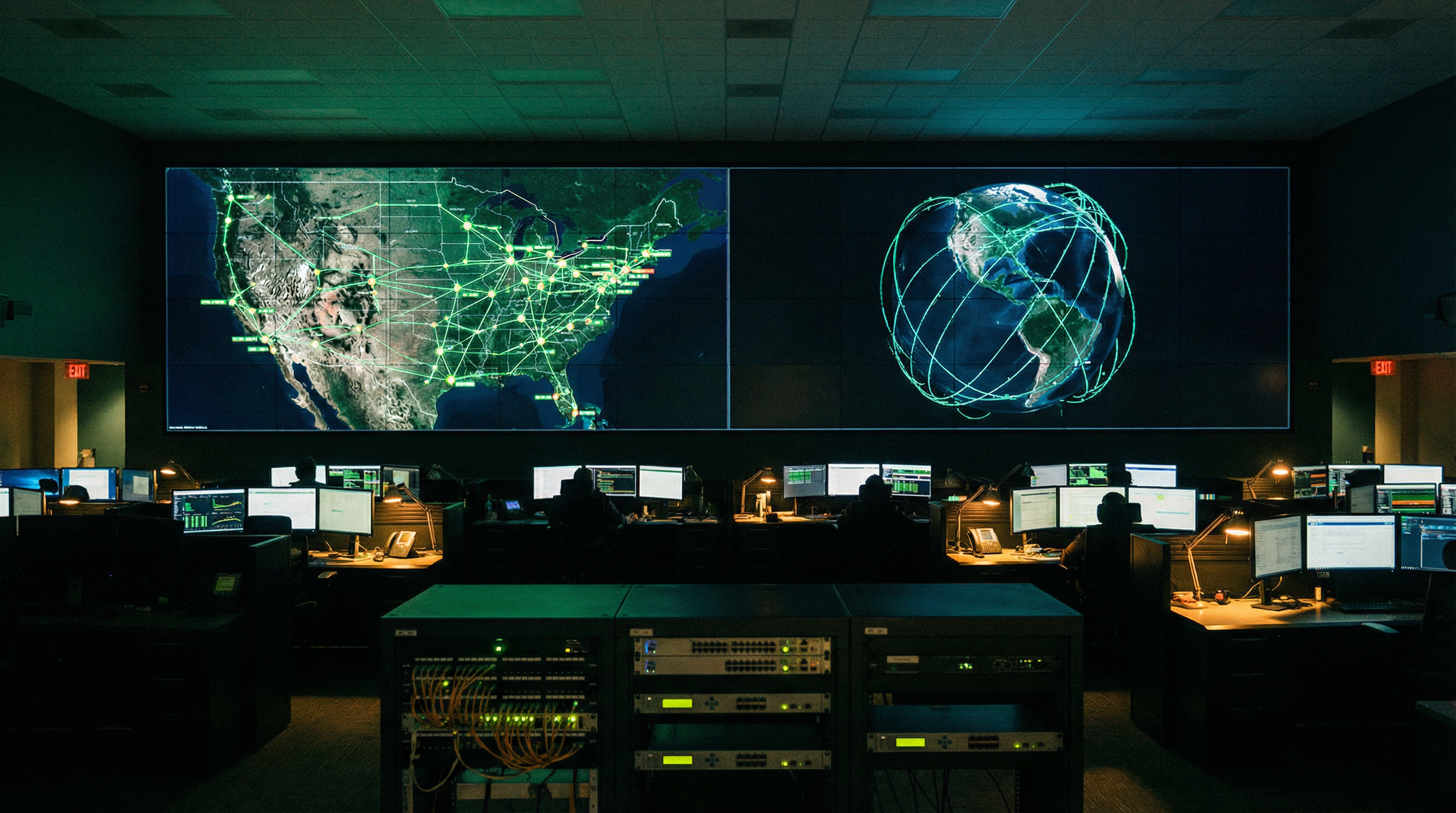
The convergence of satellite and terrestrial networks is real. 3GPP NTN has unified the subscriber experience. A device in remote Kenya can handoff seamlessly from a terrestrial tower to LEO coverage without dropping the call. The protocol layer works.
But step into the Network Operations Center, and that convergence disappears.
The NOC still runs on islands. Nokia for terrestrial cell sites. iDirect for satellite gateways. Separate dashboards for GEO coverage maps. Another console for LEO pass schedules. A spreadsheet somewhere tracking which traffic goes terrestrial, which goes satellite, which loads balance between them. Each domain has its own Network Management System. Each sees only its own network. None of them see the service the customer actually gets.
This is the operations fragmentation problem. Standards unified the device. Standards did not unify the operators who keep the network alive.
The Convergence Promise vs. the Operations Reality
Non-Terrestrial Network standards were built to answer a technical question: How do we make satellite and terrestrial networks invisible to the subscriber. The answer was elegant. Use the same 3GPP protocols. The same device OS. The same radio stacks. Converged at the air interface.
But the operations challenge is different. It is not about making networks invisible to subscribers. It is about making the entire network visible to operators. Not as five separate systems. As one.
Today, a regional operator running both terrestrial towers and satellite backhaul typically manages 5 to 15 separate monitoring consoles, each with its own alert logic, its own topology model, its own definition of “healthy.” The terrestrial NMS does not know the satellite link exists. The satellite tool does not track terrestrial load. When a customer reports no service, the operations team starts in one console, then moves to another, then calls the vendor. Twenty minutes pass. The MTTR clock is running. The customer is offline.
The standards committee did not set out to solve this problem. They were solving a different one. But operators need it solved anyway.
When Faults Cross Transport Boundaries
Most faults stay contained. A terrestrial cell site goes down. The terrestrial NMS raises an alarm. The field team is dispatched. The problem is isolated, fixed, resolved.
But satellite-terrestrial hybrid networks create a new fault class: boundaries.
A customer loses connectivity. The terrestrial tower shows healthy. The satellite gateway shows healthy. The backhaul link reports nominal. The SLA is in violation. But no single console knows why.
The fault is a story that crosses multiple systems. The terrestrial tower handed off traffic to satellite. The satellite gateway’s queue depth was already high because of another customer’s large transfer. The load balancer favored terrestrial. The backhaul was saturated at the exact moment the handoff occurred. By the time the traffic shifted back to terrestrial, the customer’s session had timed out.
Each system recorded part of the story. No system recorded the whole narrative. The correlation is manual. An experienced operator might piece it together in 45 minutes. A newer operator might take two hours, or might miss the pattern entirely.
This is where operational intelligence becomes essential. Not as an add-on. As the fabric.
One Operational Model, Every Transport Layer
The answer is an intelligence layer that sits above the individual Network Management Systems and makes the whole network visible as a unified operational domain.
This does not mean replacing your Nokia NMS or your iDirect suite. It means building a correlation layer that understands both. That knows how your topology actually flows. Where terrestrial and satellite links bind together. Which customers depend on satellite, which on terrestrial, which on both. How your billing system defines a delivered service, and how your operations systems define a healthy network.
From that unified model, operational intelligence becomes possible in ways single-domain systems cannot achieve.
Fleet health tracking that counts GEO coverage availability alongside terrestrial cell site metrics. Not as two separate KPIs, but as one composite picture: the customer’s path to network is healthy, or it is not.
SLA tracking that follows traffic as it shifts between satellite and terrestrial routes. Not static contracts that assume a fixed transport. Dynamic SLA correlation that understands where your customer’s bytes actually traveled, and whether the service they received met the promise you made.
Capacity planning that accounts for LEO pass schedules, orbital mechanics, and GEO weather fade, alongside standard terrestrial demand forecasting. Most capacity tools assume infinite, static supply. Hybrid networks have finite, ephemeral supply windows. The operational model must reflect that.
Fault correlation that automatically ties symptoms across domains. When a customer loses service, the system does not require an operator to check five consoles. It presents the likely root causes, ranked by probability, with evidence from each domain that contributed to the fault.
New operator training that is embedded in the system itself. Junior staff can learn the relationships between systems by observing what the intelligence layer sees. Over time, that institutional knowledge is not locked in one senior operator’s experience. It is codified in the operational model, available to everyone.
What This Means for Operators
The business outcome is simpler to state than the technical execution, but no less real.
Faster MTTR. When faults cross boundaries, the correlation is automatic. Your team finds root cause in 15 minutes, not 90. Your SLA breach window closes before it starts.
Revenue leakage detected. When terrestrial and satellite billing systems measure traffic differently, discrepancies hide. An intelligence model that tracks the same traffic across both systems reveals where the gap lives. Sometimes it is honest system drift. Sometimes it is configuration debt. Either way, the revenue at stake is known and remediated.
Institutional expertise at scale. Your most experienced operator carries a mental model of the entire network in their head. A new hire does not. An operational intelligence model makes that deep knowledge available to everyone. New operators perform like veterans, faster.
Predictability that compounds. Each month you run the network through this unified model, the system learns more about what normal looks like. Anomalies emerge earlier. Pattern recognition improves. The operational model becomes an asset that gets more valuable over time.
The protocol convergence happened. 3GPP NTN ensured it. But the operations convergence still requires deliberate choice. It requires building a unified intelligence model that spans terrestrial and satellite domains, that sits above individual NMS tools, that makes the whole network visible as one operational system.
Without it, your convergence is incomplete. Your team is slower. Your customers feel it.
With it, hybrid operations become sustainable, predictable, and increasingly efficient. That is where the real advantage lives.