Why Multi-Domain Intelligence Fails at the Seam
Physical security, cyber operations, logistics, and space domain awareness each have their own intelligence system. The problem isn't the systems, it's that nobody can see across the boundaries between them.
The Seam Problem
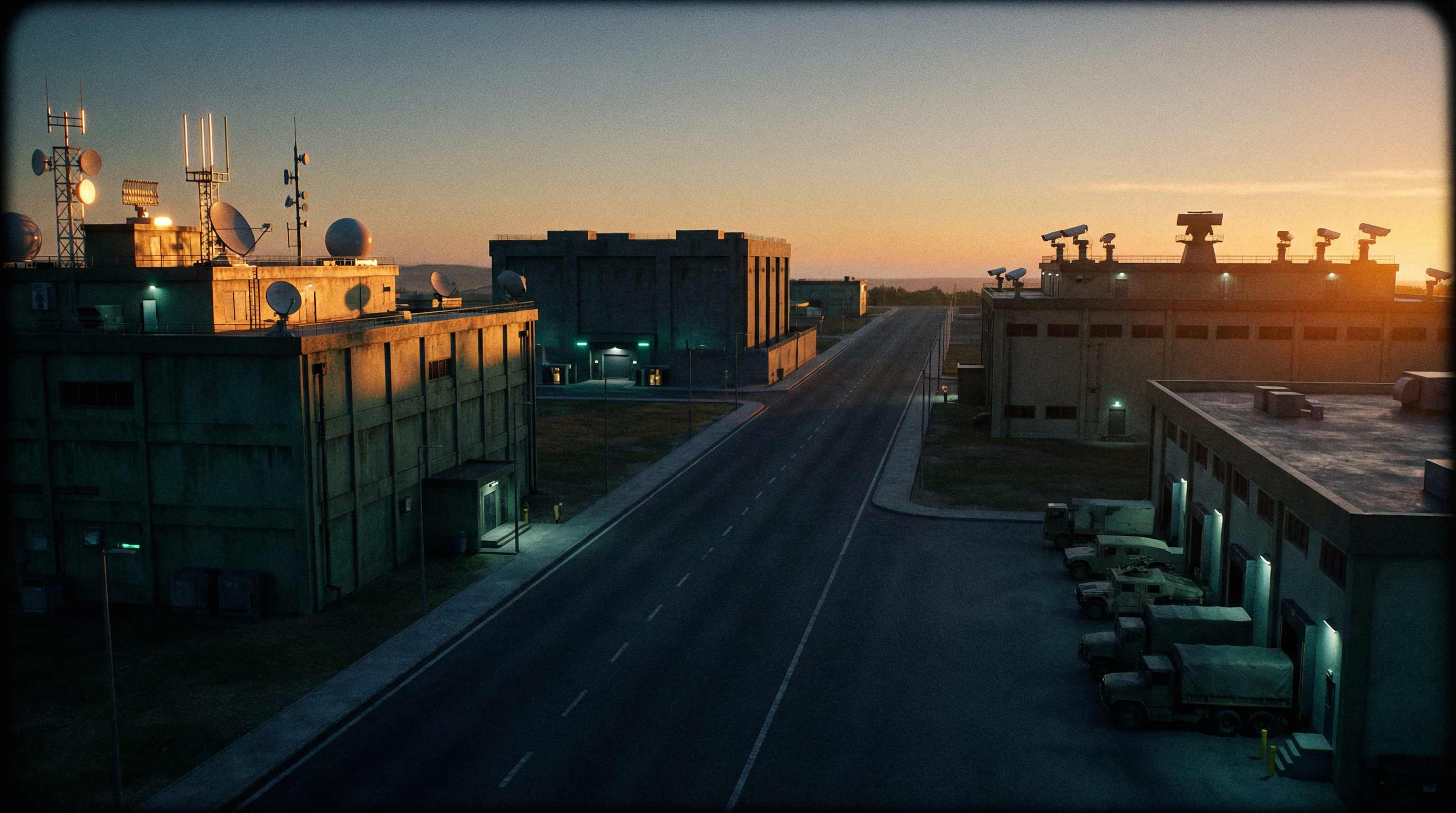
Defense installations operate like city-states with separate intelligence regimes. The perimeter fence has motion sensors. The network has intrusion detection. The supply chain has asset tracking. The satellite feeds have constellation monitoring. Each system works. Each produces alerts. Each stays in its own lane.
The problem arrives at the boundary.
Picture this: A physical breach triggers at Gate 4 at 22:47. Seventeen minutes later, a supply requisition order appears from an authenticated account. At 23:11, network traffic from that account spikes toward classified network segments. Each event is logged. Each is normal in isolation. The intrusion detection system sees the spike, but not the gate breach. The physical security team sees the breach, but not the network behavior. The logistics system sees the order, but not what comes before or after.
The threat that connects all three never appears on any screen.
This is the seam problem. Not a gap in data. Not a failure of individual sensors. A structural blind spot created by the architecture itself.
Why More Data Doesn’t Help
The natural response is aggregation. Centralize everything. Build a lake. Connect all systems to one truth.
This works for environments without classification constraints. It fails immediately in defense.
A Top Secret network cannot be merged with Secret infrastructure. An air-gapped installation cannot send its operational data to a cloud dashboard. A classified coalition operation cannot stream intelligence through unclassified federation points. These aren’t policy inconveniences, they’re operational requirements. They exist because information compartmentation saves lives.
The instinct to “break down silos” collides with the reality that those silos exist by law, by protocol, and by the physics of network security.
Trying to solve the seam problem by eliminating boundaries creates a different problem: degraded classification control, dependencies on external connectivity, and intelligence flows that violate mandate.
The real constraint is this: The system that solves cross-domain correlation must work within the constraints, not around them.
What Sovereign Operational Intelligence Looks Like
The solution has three structural properties.
Multi-domain correlation that respects classification boundaries. Instead of forcing all intelligence into one repository, correlation rules run where the data lives. A command center receives a curated, aggregated view (conclusions only) without forcing the underlying classified data across any boundary. The analyst sees the compound event. The system never violates compartmentation.
Governed autonomous response with complete audit trails. When the seam reveals a threat, response decisions must be traceable. Who authorized action? What data informed the decision? What constraints applied? In distributed, air-gapped installations, systems operate autonomously when central command cannot be reached. Autonomy is meaningless without the ability to reconstruct every decision in full after the fact. The audit trail is not compliance overhead, it is the foundation of command authority.
Federated command that maintains local autonomy. Not every installation has the same role or classification posture. Some operate at higher classification. Some are unclassified but sovereign. Some are coalition-dependent. The intelligence system must reflect local command authority while coordinating across installations. A commander in one domain must be able to request intelligence from another without surrendering operational control of their systems.
These capabilities are Tier 1 requirements, not optional. They are outcomes, not components. They define what the system must accomplish.
The Operational Test
Before committing to any intelligence integrator, test these four questions in your environment.
Can it run fully air-gapped? Deploy the system without any external connectivity. Can it correlate across domains? Can it produce operational intelligence? Or does it assume constant cloud connectivity, making it inoperable when connectivity fails?
Does every action produce an audit trail? Run a scenario where the system detects an anomaly and triggers a response. Can you reconstruct that entire event six months later? Can you prove what data was evaluated, what threshold was crossed, who authorized the action? If the audit trail is afterthought, the system fails the test.
Can distributed installations operate autonomously? If central command goes dark, can a forward operating base or isolated facility continue producing intelligence? Can it store decisions locally and reconcile them later? Or does the system become a data collector with no decision authority?
Can a commander see across domains from one interface without merging networks? The interface should present a unified operational picture. The underlying architecture should keep each domain’s data where it belongs. If the system requires you to choose between unified command view and classification integrity, it fails the test.
If any of these answers is no, the system does not solve the seam problem. It moves the problem somewhere else, usually to an analyst doing the integration manually in a spreadsheet.
The Outcome
Multi-domain intelligence is not a feature. It is a necessity. Threats are not domain-specific. They accumulate across boundaries. An intelligence system that cannot see and act across those boundaries is not protecting the installation, it is fragmenting it.
The seam is not a technical problem to be solved by more integration. It is an architectural problem to be solved by designing intelligence systems that respect the constraints of defense operations while refusing to be constrained by them.
The organizations that master this (those that build correlation within boundaries, govern response with complete transparency, and give local command its authority while coordinating across installations) will operate with clarity where others operate in ambiguity.
That clarity is operational advantage.


