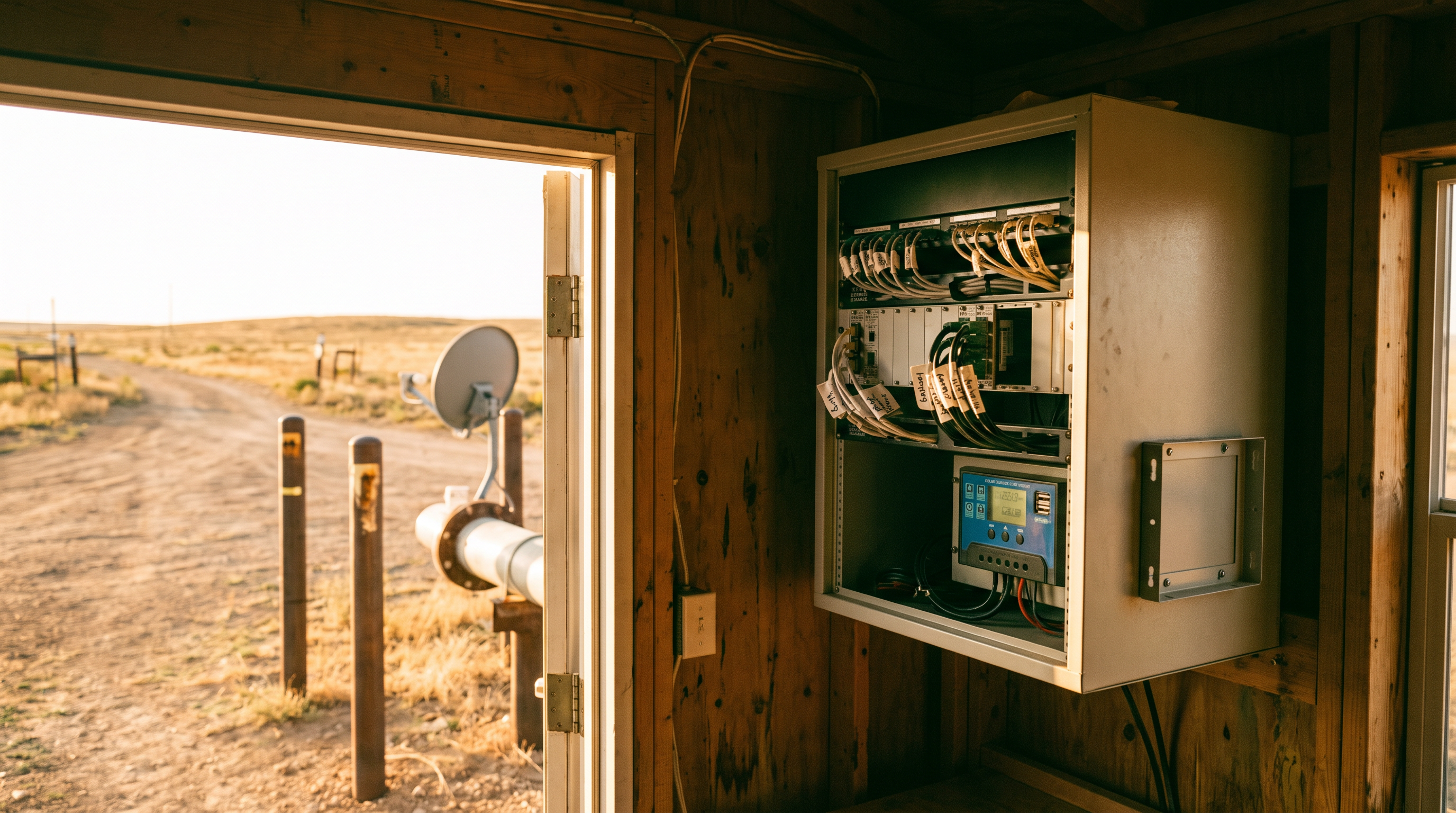
Proving It Before You Connect It
Operators of critical infrastructure are asked to evaluate new intelligence capability before anyone is permitted to touch a live system. When the evaluation and the access policy don't share a common model of what counts as evidence, pilots stall in the gap between the two.

An operator of a pipeline, a protected area, or a regional grid is told that a new capability could help. A sensible response is to ask for proof. The vendor is happy to provide it. Then the operator’s own security policy enters the conversation, and it says that no outside party connects to a production system until a long list of reviews is complete.
Both positions are reasonable. The proof requirement protects the budget. The access policy protects the operation. Taken together, they create a sequence that cannot start: the evidence needs the data, and the data needs the approval, and the approval needs the evidence.
Two sound policies that form a loop
Most infrastructure operators carry strong rules about system access. Operational technology networks are segmented for good reasons. Historian databases, control systems, and field gateways are protected because their failure has physical consequences. A request to connect a new analytics layer to any of them triggers a review that can take months.
Procurement carries its own rule, which is that capability should be demonstrated before it is funded at scale. The program office needs something to show its board. The operations team needs confidence that the new layer will not add noise to an already busy control room.
Each rule works as designed. The difficulty is that neither was written with the other in mind, so the pilot sits in the space between them. Teams often respond by shrinking the pilot until it proves nothing, or by waiting until the access review ends, at which point the budget window has moved on.
Proof has more than one source
Evidence of capability does not have to come from a live connection. Operators generally already hold material that can carry a demonstration: exported historical records, archived incident files, sample extracts from existing systems, and public or commercial data that describes the same territory. Each is a legitimate input, and each can be shared without touching a production network.
Consider what a first demonstration actually needs to show. It needs to show that separate records about the same asset can be resolved into one picture. It needs to show that the picture surfaces a pattern the current process misses. And it needs to show that someone in the operating team can look at the result and say whether it is useful. None of these steps requires write access, a live feed, or a connection to a controlled network.
A well-formed proof of value works backward from the question the operator wants answered. If the question is whether sub-threshold events can be separated from normal variation, a sample extract of historical readings is enough to test it. If the question is whether registered activity can be compared against observed activity, two exported tables and a map are enough to try it.
Designing the evidence to travel
A few design choices make a pilot easier to approve and easier to trust.
The scope is stated as questions, not as integrations. “Which of last quarter’s flagged events would a combined view have explained?” is something an operator can evaluate. “Connect to four systems” is something an operator has to defend to its security office.
The data is handled under the operator’s terms. Extracts stay within the operator’s boundary or move under a documented confidentiality arrangement. The evaluation environment is deployed where the operator prefers, including inside its own jurisdiction, and the operator controls who sees outputs.
The results are tied to records the operator can verify independently. A finding that points to a specific date, asset, and source record can be checked by the operations team in minutes. A finding that depends on trusting the method is much harder to accept.
The pilot has a defined end. A fixed number of weeks, a named set of questions, and an agreed way to decide what comes next keeps the exercise from becoming an open-ended proof that never reaches a conclusion.
What the operator learns that the demonstration cannot show
A short pilot on exported data also reveals things that no presentation can. It shows how much of the operator’s information already exists in usable form and how much sits in formats that need preparation. It shows which systems have clean identifiers and which require resolution between conflicting names. It shows how the team reacts when a combined view contradicts one of its established assumptions.
These findings shape the real program. They tell the operator where integration effort will concentrate, what the access review will need to cover, and which first use case has the shortest path to routine value. An operator who has seen this on its own data enters the access conversation with specifics, which is a far better position than a general promise of future benefit.
A shared model of what counts
The underlying condition is that evaluation and access are governed by different parts of the organization, each with a different definition of acceptable evidence. When those definitions don’t share a common model, every pilot becomes a negotiation about process, and the capability itself is rarely tested.
A real-time operational model of the operator’s assets, records, and responsibilities gives both sides something concrete to point at. The security office can see precisely which data enters the evaluation and which stays outside. The program office can see which questions the evidence is answering. The operations team can see their own information in a new arrangement and judge it on its merits.
An intelligence utility earns its place by being useful on the first day with the material the operator already has, and by earning access to live systems after that, in stages the operator controls. With 8,000+ integrations available, the technical path to connection is rarely the constraint. The sequence is what matters, and a sequence that begins with proof on the operator’s own records tends to arrive at live connection with the reviews already understood and the value already visible.