Severity Is Not Priority: The Ranking Problem in Operations Centers
Every monitoring system ships with a severity scale, and every severity scale is honest within its own domain. The trouble starts when four systems each deliver a 'critical' in the same five minutes, to the same dispatcher, who has the same two crews to send. Severity is assigned by a vendor at design time. Priority is a judgment made across incidents, at this moment, with these resources — and in most operations centers, no system computes it. A person does.
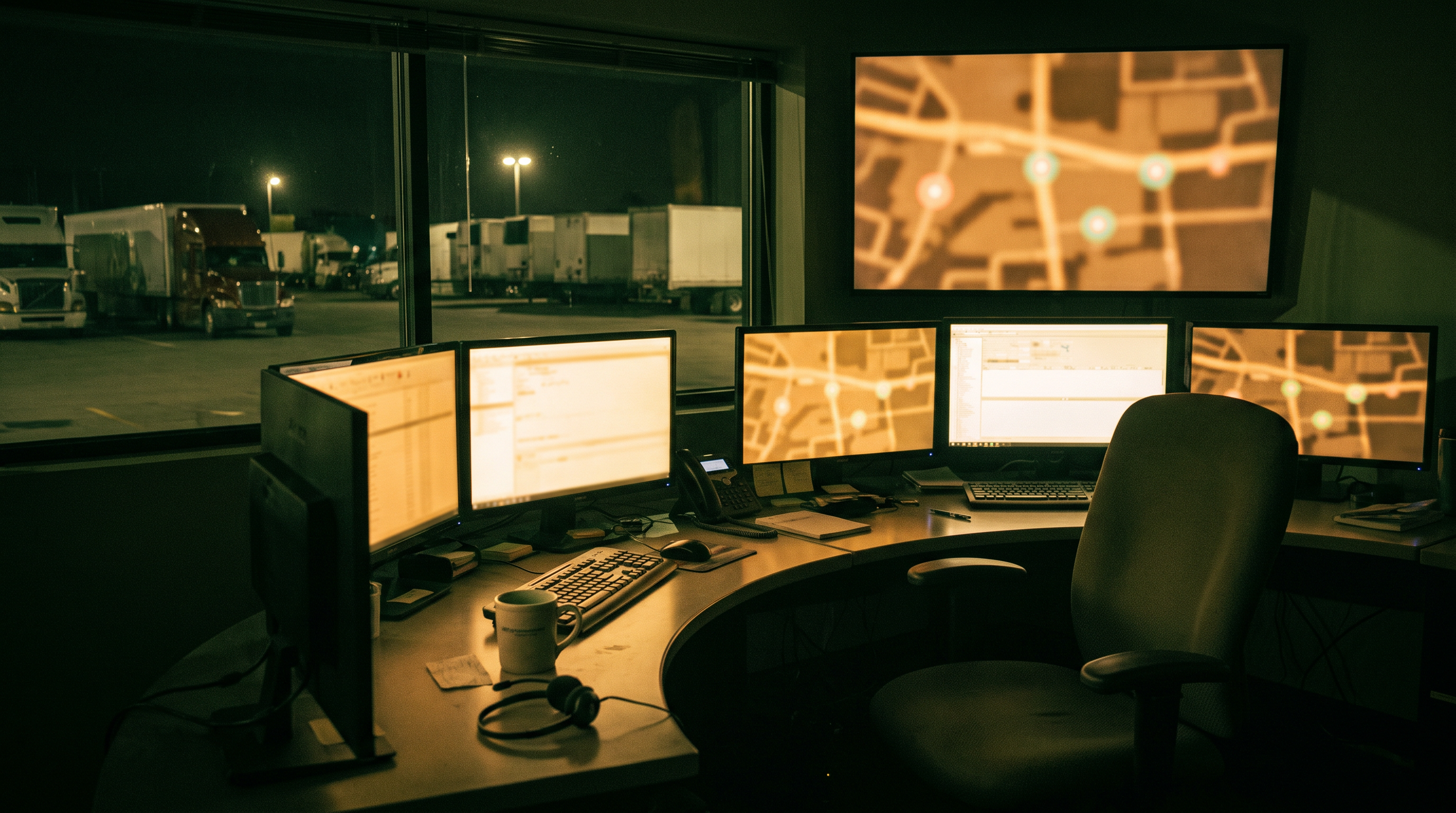
Four criticals, two crews
A little after two in the morning, a fleet operations center receives four alerts inside five minutes. A driver’s panic button, from a truck parked at a rest stop. A temperature excursion in a refrigerated trailer carrying pharmaceutical cargo. A geofence breach — a vehicle entering a zone flagged for hijacking risk. An engine fault code on a unit due at a port gate by six.
Each alert arrives from a different system, and each system is telling the truth. The panic button is critical on the personal-safety scale. The excursion is critical on the cold-chain scale. The breach is critical on the security scale. The fault code is high on the maintenance scale. Four honest severities, four different scales — and one dispatcher, with two response crews and one open phone line, who must now decide the only question that matters operationally: in what order?
Notice what the systems did and did not do. Each classified its own event, correctly, within its own domain. None of them ranked the four events against each other, because none of them can see the other three. Severity was decided by four different vendors, years ago, in four different design meetings. Priority — the actual sequence of the next thirty minutes — is being decided right now, by one person, from memory.
The queue is not a ranking
It is tempting to file this under alert fatigue and buy a consolidation tool. Most operations centers already have — the alerts land in one inbox, one wallboard, one queue. But a unified queue solves delivery, not judgment. The four criticals now arrive in the same window instead of four windows. They are still four claims of equal urgency, sorted by timestamp, which is to say: not sorted at all.
Ranking them requires facts that live outside every alerting system. The panic button matters differently if the driver triggered it inside the cab of a moving truck than at a rest stop where he stopped an hour ago. The temperature excursion matters differently if the trailer holds two hours of thermal margin or twenty minutes, and differently again depending on the value and the consignee of the load. The geofence breach matters differently if the vehicle entered the zone on a planned route. The engine fault matters differently if a substitute tractor sits forty minutes away. Which crew is closer, which incident degrades irreversibly and which one merely waits, what the contract says an hour of delay costs — none of this is in any alert. All of it is in the operation.
An experienced dispatcher carries that model in their head. They know the corridors, the customers, the thermal margins, the drivers who lean on the panic button and the ones who never would. Their two-in-the-morning ranking is usually right. It is also invisible: built from facts nobody listed, weighed by rules nobody wrote down, applied at a quality that varies with who is on shift and how deep into the shift they are.
What the unwritten ranking costs
The cost surfaces in three places.
The first is variance. The Tuesday night shift and the Saturday night shift work the same alerts in different orders, because the ranking lives in individual heads and heads differ. The operation’s real triage policy is not the one in the SOP binder — it is the union of what its dispatchers happen to do, and nobody has read that document.
The second is defensibility. When the sequence is questioned — by a customer whose load spoiled, by an insurer, by a regulator, by counsel — the operation must reconstruct why the geofence breach was worked before the excursion. The honest answer is often the dispatcher judged it so, and the dispatcher was probably right. That answer, however true, does not survive review well when there is no record of what was known at the moment and how it was weighed.
The third is fragility. The person carrying the model is a single point of failure with a resignation letter. When the fifteen-year dispatcher leaves, the operation does not lose a headcount; it loses the only complete copy of its own priority logic. New dispatchers take a year to become adequate and several to become good, and the training method is osmosis.
Priority as a computed, explainable thing
The structural shift is to treat cross-incident priority as something the operation computes rather than something it hopes the right person intuits — a ranking derived from a real-time operational model that holds what the alerting systems cannot: the assets, the cargo and its margins, the crews and their positions, the contracts and their exposure, the routes and their history.
Against that model, the four criticals stop being four equal claims. Each becomes a scored proposal: this incident, ranked here, because of these facts — the trailer has forty minutes of thermal margin and the nearest crew is fifty away; the panic-button vehicle is stationary with a heartbeat signal and a driver who answered the callback. The dispatcher sees the ranking and the reasons, not a timestamp-ordered pile.
Two boundaries keep this honest. The ranking proposes; the human commits. A dispatcher who knows something the model does not — and some nights they will — overrides it, and the override is captured with the rest. And every ranking is recorded: the facts available, the weights applied, the sequence recommended, the sequence actually run. The two-in-the-morning judgment stops being invisible. It becomes a record the operation can review, defend, and — shift after shift — learn from, because the gap between what the model proposed and what its best dispatchers chose is precisely where the unwritten policy becomes visible enough to write down.
For the routine tail of the queue — the low-consequence alerts with well-worn responses — the same recorded rules can carry actions through on their own, as governed autonomous action with the audit trail intact. The scarce resource, the dispatcher’s attention, is spent where the ranking says the operation has the most to lose.
The question to ask the ops center
There is a quick way to locate an operation on this curve. Pick a busy night from last month and ask: why were these five incidents worked in this order?
If the answer comes from a system — here was the queue, here were the facts, here was the recommendation, here is where the dispatcher overrode it and why — the operation owns its priority logic. If the answer is a shrug toward the best dispatcher on the floor, the logic exists, works most nights, and belongs to someone who can quit.
Severity will always arrive from the outside, one scale per system, honest and incomparable. Priority is the operation’s own judgment about its own next half hour. It deserves better custody than one tired head at two in the morning.