The Lender Who Owns the Service Bay
Captive lenders hold an advantage no bank can buy: the asset they financed drives back into their own building every few months. The service bay sees the truck's condition, its usage, its deferred repairs — the leading indicators of how the loan will perform. When the credit file and the service record don't share a common model, the lender underwrites with a bank's information and a dealer's overhead, and the advantage goes unused.
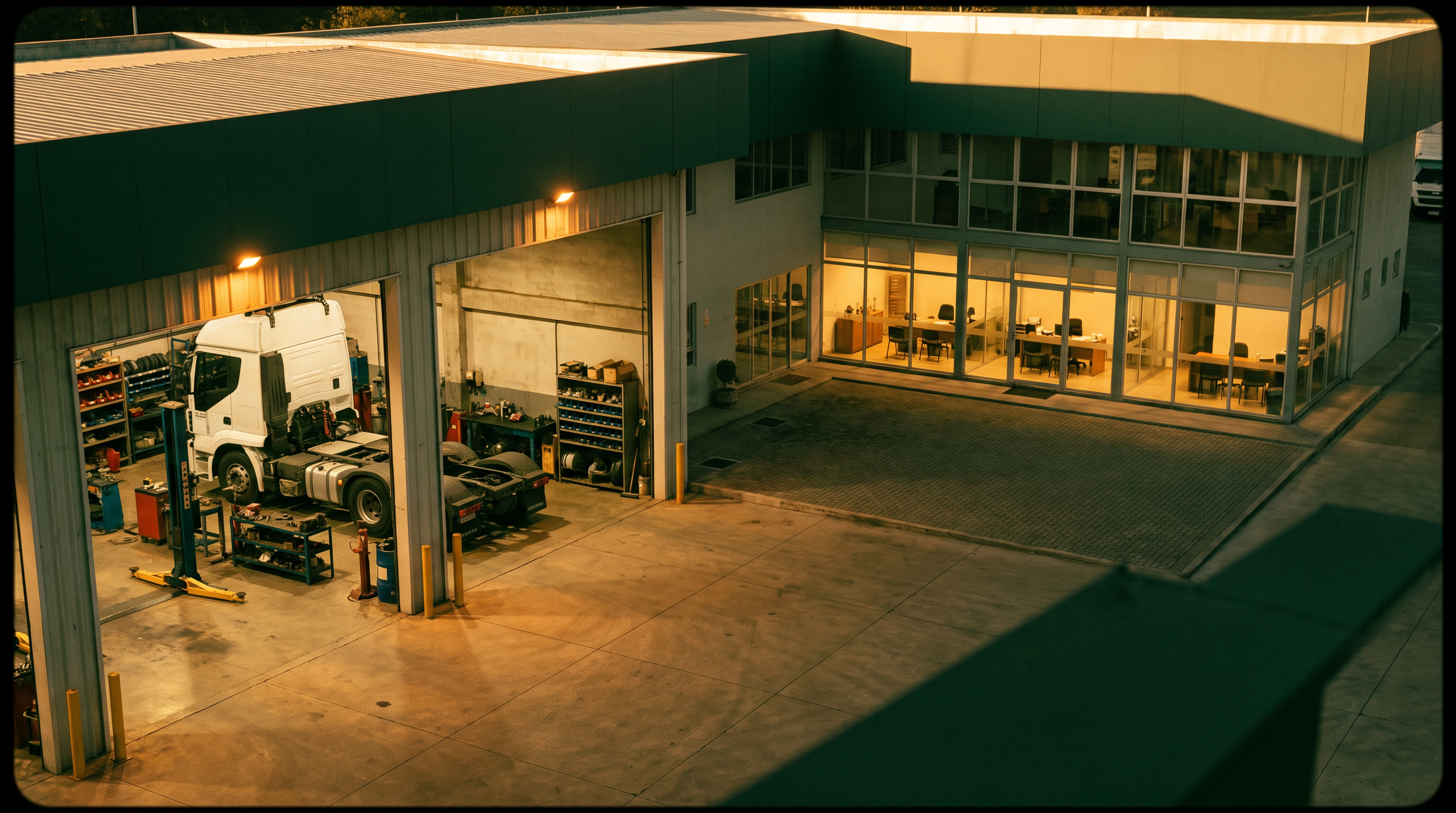
The default that announced itself
A commercial truck stops making its loan payments. The captive finance arm of the distributor that sold it opens the file: eighteen months of clean payments, then two late, then silence. The account moves to collections, then to recovery. When the truck finally comes back, the remarketing team discovers what the auction will confirm — worn injectors, a clutch at end of life, sixty thousand kilometers more than the amortization schedule assumed. The recovery value is a fraction of the outstanding balance.
Three hundred meters away, in the same company’s service operation, that outcome had been legible for a year. The truck missed its scheduled maintenance twice. The kilometers between visits kept climbing while the invoiced work kept shrinking — the owner was running the asset harder and spending less to keep it alive. The last visit ended with a declined repair estimate. Any service advisor reading that file would have told you the operator was in trouble. Nobody asked, because the service record and the credit file describe the same truck to two departments that have never shared a picture of it.
Nothing in that sequence failed for lack of diligence. The finance team watched what finance systems watch: payment behavior. The service team recorded what service systems record: work orders. Both did their jobs. The loss lived in the space between them.
An advantage priced at zero
Captive and dealer-affiliated lenders exist because they can do something banks cannot. A bank that finances a truck sees a payment stream and a depreciation curve. A captive lender sees the asset itself — in its own workshop, on a lift, several times a year, examined by its own technicians. It knows the real kilometers, the real condition, the real appetite of the owner to maintain what they owe money on.
That proximity is the economic argument for captive finance. It is why the distributor carries the credit risk instead of handing the margin to a bank: the theory says the company that sells, services, and finances the asset understands it better than anyone else, and should price risk accordingly.
Walk through most captive finance operations and the theory stops at the org chart. Underwriting runs on bureau data, financial statements, and payment history — the same inputs a bank uses, often in the same software a bank uses. Portfolio monitoring means aging reports. The service operation, meanwhile, generates exactly the signals a lender would pay for — utilization, condition, maintenance discipline, declined repairs, a sudden change in who brings the truck in — and writes them into a system whose only reader is the next technician.
The structural condition is easy to state. Payment history is a lagging indicator: by the time it moves, the borrower’s operation has already deteriorated. Asset condition is a leading indicator: it moves first, and it moves in a building the lender owns. When the two don’t share a common model, the lender learns about every problem in the most expensive possible order — missed payment, then failed collection, then a recovery whose value is discovered at auction instead of known from the record.
The gap runs in both directions
The same wall costs the service side. A fleet customer calls to schedule a major engine overhaul — significant parts, significant labor, invoiced on account. The service advisor books it, orders the parts, and commits the bay. The finance arm, three months into a delicate restructuring conversation with that same customer, learns about the new receivable when it appears in the month’s numbers. Or the mirror image: collections places a firm call to an account that, unknown to them, just paid cash for the most responsible thing a struggling operator can do — a preventive repair that protects the collateral. The call lands as an insult, and the relationship that captive finance is supposed to be built on absorbs the damage.
Every one of these moments is two departments acting reasonably on half a record.
What the shared picture looks like
The answer is not a bigger credit system, and it is not giving the shop floor access to loan files. The two records need different confidentiality, different retention, different regulators. What they need to share is a model, not a database: the truck as one entity, about which both operations contribute facts and from which each reads only what it is entitled to read.
In a real-time operational model, the asset carries its financing state and its physical state as facts about the same thing. Governance decides who sees what — the service advisor never sees a balance, the underwriter never reads a technician’s notes, but the portfolio watchlist can still move when the maintenance pattern breaks. That distinction matters in practice: connecting the records is a data problem; connecting them without leaking credit information into a workshop or repair details into a collections call is a governance problem, and it is the harder of the two.
With the model in place, the questions the captive lender was built to answer become answerable:
Which performing loans are deteriorating physically? Payment current, maintenance abandoned, kilometers accelerating — the profile of a default that hasn’t happened yet. A watchlist built on those facts surfaces trouble while there is still a truck worth recovering and a customer worth restructuring.
What is the collateral actually worth? Not the depreciation table’s opinion — the service record’s. Recovery decisions, refinance terms, and end-of-term buyout offers all improve when the asset’s condition is a known fact instead of an auction-day surprise.
Who has earned better terms? The operator who never misses a service interval is a better risk than their bureau score shows. The lender who can see that discipline can price it — and the offer writes itself from facts the company already owns.
None of this asks anyone to stop exercising judgment. The watchlist proposes; a portfolio manager decides what a broken maintenance pattern means for this customer, in this season, with this history. The point of the shared model is that the decision is made with the whole record, and that the reasoning — which facts, which threshold, which recommendation — is kept, so the next reviewer inherits the judgment and not just the outcome.
The measure of the structure
There is a simple test for whether a captive finance operation is using the advantage it pays overhead to maintain: when a loan goes bad, was the first warning a missed payment, or something the company’s own workshop recorded months earlier?
If the answer is the missed payment, the lender is running a bank’s risk model from inside a building full of better information. The trucks come back every few months and tell their story to a system that never repeats it. The structural fix is not more data — the data exists, on the company’s own servers, written by its own employees. It is one operational model over the asset both departments already know, governed so each side sees what it should, watched so the leading indicators lead.
The lender who owns the service bay should never be the last to know how the loan is going.