The Port Is Four Companies Sharing One Fence Line
A container that spends five days in a terminal did not spend five days being handled. It spent most of them waiting at a handoff between parties who each run their own system, on their own clock, optimizing correctly for their own contract. Dwell time is created in the gaps between organizations, and no one inside the fence line owns the gap.
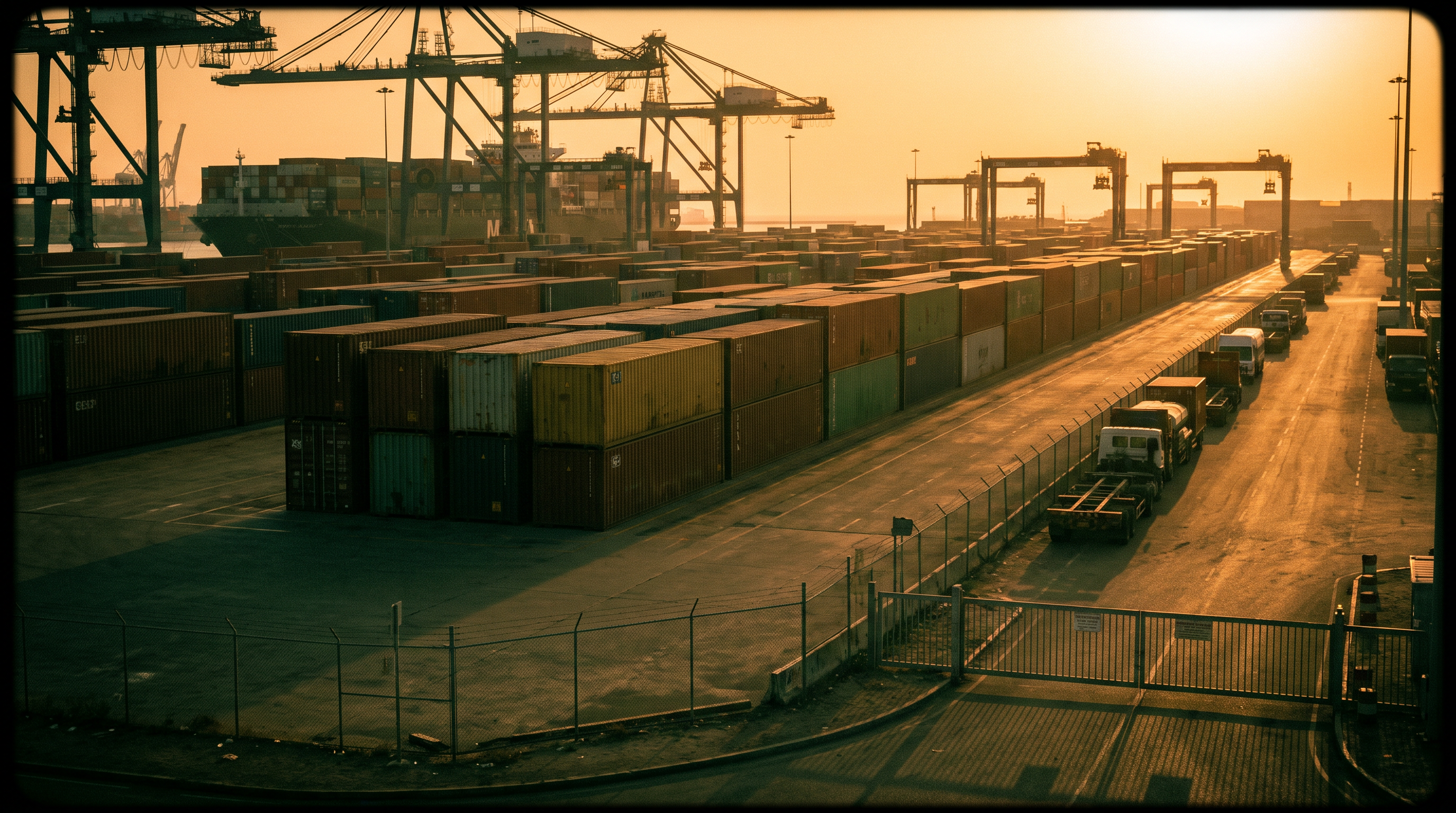
Where the days actually go
A box comes off a vessel on Tuesday morning and leaves the gate on Sunday afternoon. Ask the terminal how long it took to discharge and stack it and the answer is measured in minutes. Ask the customs broker how long the declaration took and the answer is hours. Ask the haulier how long the drayage run takes and the answer is under two hours, door to door.
Add up everything anyone did to that container and it comes to well under a day. The other four sat in the space between one party finishing and the next party starting.
This is the shape of most port performance problems, and it is why they resist the obvious fixes. Terminals buy larger cranes, better yard planning, automated stacking, and the discharge curve improves. The dwell curve does not move much, because dwell was never mostly about discharge. It is about the handoffs — vessel to yard, yard to customs, customs to release, release to gate, gate to haulier — and a handoff belongs to two parties and to neither.
Four organizations, one fence line
The thing that makes a port hard is not that it is complicated. It is that it is a single physical operation run by parties who do not report to each other.
The terminal operator holds the yard: berth windows, crane allocation, stack positions, gate throughput. The shipping line holds the cargo commitment: vessel schedules, container ownership, demurrage clocks, release authority. The haulier or transport operator holds the road side: driver hours, appointment slots, chassis or trailer availability, the next three jobs. Customs and border authorities hold the legal gate: declarations, inspections, holds, clearance. In most ports a port authority sits above all of it holding infrastructure, security, and statistics but not day-to-day cargo decisions.
Each of these parties runs a competent system. Terminal operating systems are mature. Customs declaration systems are mature. Transport management systems are mature. None of them is broken.
What none of them holds is the box’s whole life inside the fence. Each holds the segment it is accountable for, timestamped on its own clock, in a vocabulary its own auditors recognize. The terminal knows the container was available at 14:20. The broker knows clearance posted at 09:15 the next morning. Whether those two facts describe a nineteen-hour wait or a normal overnight depends on a third fact — when release actually reached the haulier — that lives in a fourth system, if it was recorded at all.
Everyone is optimizing correctly
The reason this persists is not indifference. It is that each party is optimizing well against its own contract, and the local optima do not sum.
The terminal is measured on berth productivity and yard utilization. Holding boxes longer is not a failure by that measure; a full yard is a used yard. The shipping line is measured on vessel turnaround and asset recovery, and demurrage is revenue, which makes slow pickup something other than a pure cost. The haulier is measured on trucks moving, and a driver who queues ninety minutes at a gate has lost a job — so hauliers build slack, arrive early, and queue defensively, which makes the queue longer. Customs is measured on compliance and revenue integrity, and an inspection that takes an extra day is not a performance problem for customs; missing a misdeclaration is.
Put those four incentive structures inside one fence and you get exactly what ports get: high equipment utilization, high individual-party performance scores, and cargo dwell that nobody can explain and everybody can defend.
The structural condition is simple to state. When four organizations share one physical operation but not one operational model, the time created between them is invisible to all of them and owned by none.
Why a shared dashboard is not the answer
The instinct is to build a port community view — one screen where everyone posts status. Many ports have. The results are real but usually smaller than expected, for three reasons worth naming.
The first is that a shared screen is a shared report, not a shared model. Parties post what they are willing to post, when they get to it. The screen shows the last thing someone typed, not the state of the operation.
The second is that the parties are commercial rivals in places and commercially exposed everywhere. A haulier’s appointment book, a line’s demurrage exposure, a terminal’s yard congestion, a shipper’s cargo value — these are not facts anyone hands to a neighbor because a portal asked. Visibility projects that require open books stall on a legitimate objection, and the objection does not go away because the benefit is mutual.
The third is that the useful question is not “what is the status.” It is “what happens next and who has to move.” A status board answers the first. Nobody built to answer the second.
One model over the box, governed per fact
The version that holds up treats the container — not the party — as the thing the model is built around, and treats visibility as something granted fact by fact rather than system by system.
In that arrangement, the box has one continuous record: discharged, stacked, declared, held, cleared, released, appointed, gated out, with each event timestamped on a common clock and attributed to the party that produced it. The record is written by all four parties and readable by each of them only to the extent their role and their contract permit. The haulier resolves the appointment, the release status, and the expected gate wait. The line resolves the demurrage clock and the cargo state. Customs resolves the declaration chain and the inspection history. The terminal resolves the yard and the flow. Nobody resolves a competitor’s book, because the policy sits on the fact, not on the login.
What changes when the record is continuous is that the gaps stop being invisible. A container that has been cleared for eleven hours with no appointment booked is not a mystery to be reconstructed at month end; it is a condition the model can see while it is still happening, and a specific party can act on. So can the reverse: a haulier whose truck is en route to a box that just went on hold learns it before the driver joins the queue.
This is also where the routine tail becomes tractable. Most of the coordination inside a port is not judgment — it is the same handful of moves executed thousands of times: a cleared box that needs an appointment, a hold that needs the right party notified, a slot that opens and should be offered to the truck already at the gate. Those can run as governed autonomous action with the reasoning recorded, which leaves human attention for the exceptions: the inspection that will cascade into three missed appointments, the vessel bunching that will fill the yard on Thursday, the shipment whose consignee will not tolerate another day.
And because each event is signed and the record is bitemporal, the disputes that consume so much of a port’s management time — who caused the demurrage, whose delay triggered the detention charge, whether the hold or the haulier came first — stop being a negotiation between four sets of logs and become a question with an answer.
The question to ask at the gate
There is a fast diagnostic for any terminal or port operation. Pick a container from last month with unremarkable, unexceptional dwell — five days, no incident, no complaint. Ask what it was waiting for, hour by hour.
If the answer requires pulling exports from four systems, aligning three clocks, and a meeting, the operation does not have a model of its own throughput. It has four accurate accounts of four different segments, each of which is defensible, none of which contains the thing everyone actually wants to know.
Ports do not lose days to bad cranes. They lose them to the space between organizations that share a fence line and nothing else. Closing that space does not require anyone to merge, to give up a system, or to open a book. It requires the box to have one record, and each party to see the part of it they are entitled to — which is a smaller ask than it has historically been treated as, and the only version of port visibility that four independent parties have any reason to agree to.